Image

| Registration Type | Member Price |
|---|---|
| Early Bird Registration (Sept. 11-Oct.3) | $750 |
| General Registration (Oct. 4-Oct.17) | $850 |
| Registration Type | Member Price | Non-Member Price |
|---|---|---|
| Early Bird Registration (Sept. 11-Oct. 3) | $750 | $850 |
| General Registration (Oct. 4-Oct.17) | $850 | $950 |
Not a member? We'd love to have you join us for this event and become part of the Chorus America community! Visit our membership page to learn more, and feel free to contact us with any questions at [email protected].
| Registration Type | Non-Member Price |
|---|---|
| Early Bird Registration (Sept. 11-Oct. 3) | $850 |
| General Registration (Oct. 4-Oct.17) | $950 |
Think you should be logged in to a member account? Make sure the email address you used to login is the same as what appears on your membership information. Have questions? Email us at [email protected].
| Registration Type | Price |
|---|---|
| Individual Session | $30 each |
| All Four (4) Sessions | $110 |
*Replays with captioning will remain available for registrants to watch until November 1, 11:59pm EDT.
Member Professional Development Days are specially designed for Chorus America members. If you're not currently a member, we'd love to welcome you to this event, and into the Chorus America community! Visit our membership page to learn more about becoming a member of Chorus America, and please don't hesitate to reach out to us with any questions at [email protected].
| Registration Type | Price |
|---|---|
| Individual Session | $30 each |
| All Four (4) Sessions | $110 |
*Replays with captioning will remain available for registrants to watch until November 1, 11:59pm EDT.
| Registration Type | Price |
|---|---|
| Individual Session | $30 each |
| All Four (4) Sessions | $110 |
*Replays with captioning will remain available for registrants to watch until November 1, 11:59pm EDT.
Member Professional Development Days are specially designed for Chorus America members. If you're not currently a member, we'd love to welcome you to this event, and into the Chorus America community! Visit our membership page to learn more about becoming a member of Chorus America, and please don't hesitate to reach out to us with any questions at [email protected].
The numbers don’t lie—mail is still the most powerful fundraising tool. From personalization to timing, these practical tips will help your next appeal letter deliver real returns.
When I first began my career in fundraising, I was surprised to learn that “snail mail” is still, by far, the most effective method of asking for money. More than a decade later, that remains true. Compared to fundraising emails, mailed letters cut through the digital noise, have higher response rates, and generate larger average gifts. Even more surprisingly, donors are more likely to give online after receiving a mailed appeal than after receiving an e-appeal. The results are clear—mail is here to stay.
As you finalize your end-of-calendar-year fundraising appeal, here are a few pointers for a compelling—and effective—mailed letter. Don't miss the downloadable sample appeal letter at the end!
Why is this first on our list? In the 1970s, Siegfried Vögele conducted eye-scanning experiments to record how people react when they open direct mail. (Yes, there’s an official science to direct mail!) His research found that when we open a letter, we glance at the logo and address block and then skip straight to the signature line. It makes sense: We want to know and trust the letter-writer before we’re ready to read. If possible, write the letter “from” the head of your organization; this makes the donor feel like the artistic director or executive director knows them personally.
Since our eye is automatically drawn to the bottom of the letter, the P.S. is actually the first thing we read. This is your moment for an “elevator pitch,” and it can be an extremely effective hook. State exactly what you want the reader to do (donate!), why their donation matters, and the easiest way to get it done.
My first instinct when I sit down to write a fundraising letter is to tug on the donor’s heartstrings. I want someone to read my letter and get emotional! This passion for what we do is exactly what makes us phenomenal at nonprofit work. Unfortunately, your request for a donation can easily get lost in a long, heartfelt wall of text. Use your other emails and newsletters throughout the year to share donor stories or long-form impact reports. For this letter, keep your sentences and paragraphs short, and don’t be afraid to use bulleted lists, bold or underline key phrases, and repeat the most important call to action.
Even for a seasoned fundraiser, it can be hard to gauge the right ask. However, don’t be tempted to just ask everyone for “a donation.” A specific dollar amount is more compelling. If your database is set up for easy reporting, pull your recipient list with the “last gift” field and make sure you are asking for that amount or more this year. If not, try sharing specific examples of what a small, medium, or larger gift could do for your organization (for example, “A gift of $75 provides one ukulele for our music classroom!”). We’ll dive more into personalizing your appeal later in this list.
What makes you so special? If your organization serves an area with a lot of performing groups, use this letter to underscore what makes you unique. This is also the time to clearly articulate why you need philanthropic support in addition to other sources of revenue. This is especially important for arts organizations, where a prospective donor may be wondering why they are being asked to give a donation when they already paid for performance tickets or even a subscription.
When you’re getting ready to send a large appeal, build in time for data maintenance. Are names and addresses updated and spelled correctly? Are you aware of any donors who have passed away, married, or divorced since your last mailing? Remember, Vögele’s studies found that readers glance at the address block first. An error there can really upset a donor, or at the very least make them feel unimportant.
If you’re just sending a few letters, you can personalize them one by one. But what if you’re sending 1,000 letters? This is when segmentation saves the day. Divide your letter recipients into groups of people in similar circumstances and then create several different versions of your letter, or use Microsoft Word’s Mail Merge function. This way you can customize your message to each group while still saving time. Some basic segments might be:
More sophisticated segmentation really lets your donor feel that you know them personally. Try pulling in the number of years they’ve been giving to your organization, the last concert they attended, or even just their first names instead of a formal salutation.
The sky’s the limit with segmentation, but don’t get overwhelmed if this is starting to sound like a lot. The goal here is to help every donor feel important while being as efficient as possible with your staff time. If you only have time to personalize one aspect of your letter, focus on thanking those who have given to your organization in the past.
“Great, you’ve convinced me! Now what?” This seems like a no brainer, but maybe the most important thing you need to do in a fundraising letter is tell the donor how to send you money! Always include a gift form and business reply envelope that can be mailed back with a check, and provide a short, easy URL where a donor can make an online gift. If your letter is coming from the executive director but you want someone else to receive correspondence, make sure to call that out in your letter as well.
Every organization has followers who love what they’re doing but can only contribute $10. A great appeal letter will make that person feel like their $10 matters too, even if the overall fundraising goal is ambitious. One of the most compelling ways to do this is to set up a matching campaign. Approach a donor (often a board member) who knows you well and ask if they would be willing to match the amount raised by this appeal, up to a certain limit. This does not have to be a large amount. Just mentioning a match in your letter helps smaller-dollar donors feel that their gift will have a big impact—and that it’s worth taking the time to send in their gift.
Timing really is everything. If you’re able to send more than one fundraising appeal each year, consider asking for a donation shortly after a performance or other newsworthy moment, while you still have potential donors’ attention. If you’re sending one appeal, plan for the fall so your donors have time to consider your request for their year-end giving. About one third of annual charitable contributions are made in the month of December alone, and you want to ride that wave. Specify a clear deadline in your letter and don’t wait until the end of December to get it out the door!
It takes a lot of effort to get an appeal like this out the door. You cleaned up your data, drafted the letter, got it approved, merged the files, printed, signed, folded, stuffed, stamped, and schlepped it to the post office. Whew! Unfortunately, this is just the beginning of your work as a fundraiser, because now it’s time to follow up on all those letters.
This is where email is your friend. A multi-channel approach (i.e., mailed letter and email, social media posts, texts…) reinforces the message from your letter, catches a donor’s attention while they’re already online, and directs them to the donation page on your website.
Include yourself in your mailing, so you know when your letter hits mailboxes. Then you know it’s time to start your follow-up! This can be as simple or as rigorous as you want, but at least two additional touchpoints are needed to catch most people’s attention. Here’s an easy routine that you can replicate for all of your appeals:
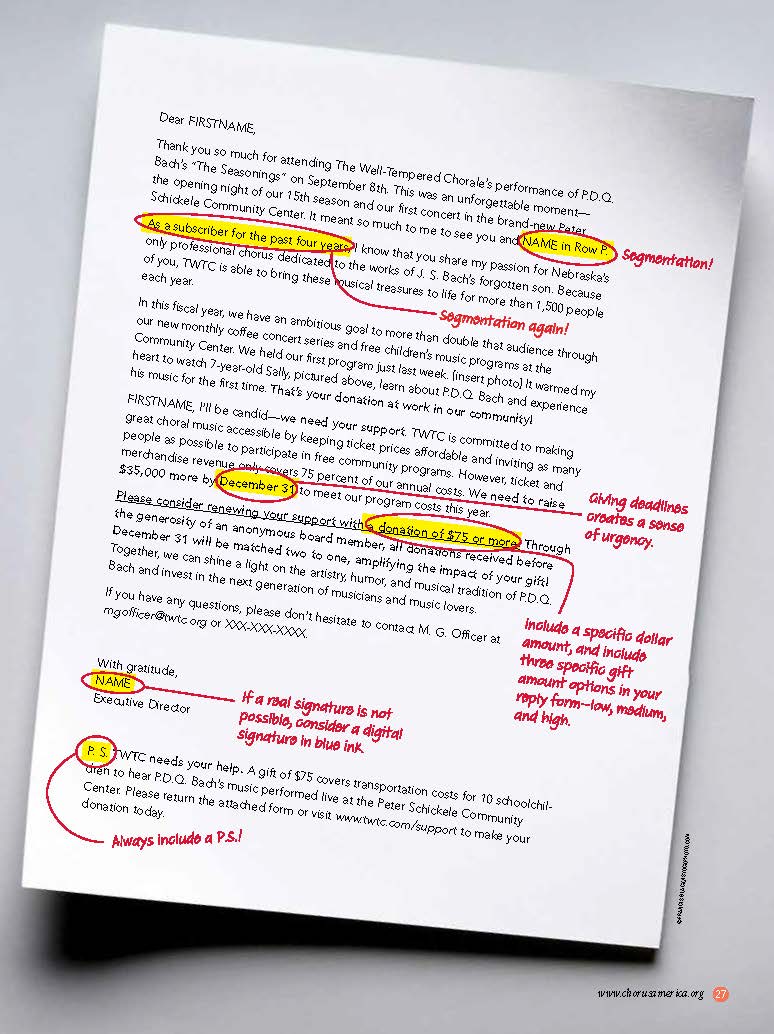
Here’s a sample (and humorous, if you know P.D.Q. Bach) appeal letter using some of the tactics in this article. Can you spot the segmentation fields?
Feel free to borrow this template and make it your own. Happy fundraising!
Liz Goldberg is a ten-year veteran of fundraising in the arts and culture sector, most recently as the Director of Individual Giving at the John F. Kennedy Center for the Performing Arts. In June, she embarked on a new role as Director of Philanthropy, Northeast and Mid-Atlantic, at American Rivers, but her musical life continues as a singer and Trustee at the Cathedral Choral Society in Washington, DC. Liz holds a MA in Arts Administration, Education, and Policy from the Ohio State University and a BA in Music Performance from St. Mary's College of Maryland, and currently resides in a house full of music and laughter in Maryland with her husband and two toddlers.
Visit Chorus America's Resource Center to download this sample appeal letter.
Not yet a Chorus America member? Learn more about the many benefits of membership and how to join here or by emailing [email protected].